Showing posts with label polenta. Show all posts

Thursday, May 23, 2024

Scallops and Baby Artichokes over Polenta


It's unusual to find baby artichokes in the market, so when I saw them, I snapped them up immediately. I couldn't wait to cook with these tender gems that were the size of Brussels sprouts. I thought they'd pair well with scallops and the combo did not disappoint. I enjoyed the artichokes so much, I quickly went back to the store for more so I could use them in a risotto. 

It won't be easy to find baby artichokes, and the season is almost over, so don't hesitate for long. If you can't find baby artichokes, you can try the recipe with frozen artichoke quarters instead. There isn't much trimming to do with baby artichokes, since there's barely any choke at all. Just slice the top portion, trim a bit of the bottom stem and pull off the first layer or two of leaves. Cut in half and place them in a bowl of water with some lemon juice or vinegar so they don't discolor too much.


Once you've cooked the scallops and the artichokes separately, bring them together in one pan and finish the recipe. If there isn't enough sauce to your liking, you can always add a little more water, wine and/or lemon juice. If polenta isn't your thing, this dish is great with rice too.

Check out Ciao Chow Linda on Instagram here to find out what’s cooking in my kitchen each day (and more).

Scallops and Baby Artichokes over Polenta

12 large sea scallops (generously serves 2 people)

2 tablespoons olive oil (or 1 tablespoon olive oil and 1 tablespoon butter)

salt, pepper to season the scallops

7 or 8 baby artichokes, cleaned and halved

1 tablespoon olive oil

1 small shallot

1 clove garlic minced

2 tablespoons water

1/4 cup white wine

1 tablespoon capers

minced parsley

juice of half a lemon

1 cup polenta

4 cups water

1 cup milk

salt, to taste

Trim the artichokes by cutting off the top portion where the prickly tips are, the bottom edge of the stem, then pulling off the toughest leaves. With baby artichokes, there isn't as much waste as on large artichokes so you won't need to pull off that many leaves. There isn't much of a choke either, so you don't have to clean out the middle. Place in a container with water and either lemon juice or vinegar.

Dry the scallops well. Heat a cast iron or heavy skillet till it's screaming hot. Add the olive oil and sear the scallops on both sides, to give them a good brown color. You don't want to fully cook them just yet. Remove them and set them aside, and let the pan cool down a little. Add the 1 tablespoon olive oil to the pan and cook the minced shallots until they are transparent, then add the garlic and cook till softened. Drain the artichokes from the water and add to the pan with the shallots. Add the 2 tablespoons of water, and season with salt and pepper. Cover the pan and cook on low heat for about 10 minutes or until the artichokes are tender. If you need to, add more water.

Place the scallops back in the pan with the artichokes and turn up the heat, adding the wine. Add the capers. Season with salt and pepper. Cook for five minutes or less, until the scallops are cooked through. Add the lemon juice and parsley and serve over polenta.

You can use either instant polenta or long cooking cornmeal. I find starting with cold water makes the polenta less likely to be lumpy. Cook over medium heat and stir with a whisk until it gets too thick, then switch to a wooden spoon. Add the water and milk all at once in the beginning, but if it's too thick, add more water or milk till you get the desired consistency you want.


Thursday, January 9, 2020

Pork Chops in Lemon Caper Sauce and Oven-Baked Polenta

While the calendar says the days are getting shorter, it’s still a long way until warm weather and eating dinner on the patio. With several months ahead of us when the threat of snow is in the air (and on the ground), comfort food sometimes is just the right thing. This dish, which I found in the New York Times, but is originally from Toni Tipton-Martin’s  “Jubilee: Recipes From Two Centuries of African American Cooking,” fits the bill perfectly for one of those stay-in types of days when the fire is roaring and that bottle of pinot noir pleads to be opened.

I accompanied it with polenta to sop up all that sauce (by the way, the recipe calls for four pork chops but I cooked just two and made the full sauce recipe). I’ve made polenta many times, both the old-fashioned way, stirring for 45 minutes and in the slow cooker. One of my cousins in Italy told me she makes it in the oven, where it practically requires no tending, so I thought I’d give it a try. It really works! And it was soft and creamy, just as I like it.

Broccoli Romano  — one of my favorite vegetables — was available in my supermarket, so I served that alongside the meat and polenta. I’m getting hungry again just looking at the pictures. I hope you give this a try.

Click here to connect with me on Instagram and find out what Ciao Chow Linda is up to in the kitchen (and other places too.)

Pork Chops in Lemon Caper Sauce and Oven-Baked Polenta
Author: Ciao Chow Linda
Ingredients
  • 4 bone-in pork chops (about 8 ounces each)
  • Kosher salt and freshly cracked black pepper, to taste
  • ½ teaspoon dried thyme leaves
  • 2 tablespoons olive oil
  • 4 tablespoons unsalted butter
  • 1 very small shallot, minced (about 1 tablespoon)
  • 2 garlic cloves, minced (about 1 teaspoon)
  • 2 teaspoons all-purpose flour
  • 1 cup dry white wine
  • 1 ½ cups chicken stock, homemade or low-sodium, if store-bought
  • 2 tablespoons drained capers
  • 2 tablespoons minced fresh parsley, plus more for garnish
  • 1 teaspoon freshly grated lemon zest, plus 2 tablespoons juice
  • Hot sauce (optional)
  • FOR THE POLENTA:
  • 1 1/4 cups cornmeal (I use Anson Mills)
  • 3 cups water
  • 1 cup milk
  • 1/2 teaspoon salt
  • 3 tablespoons butter
  • 1/2 cup grated parmesan cheese
Instructions
  1. Dry the chops with paper towels, and season aggressively with salt, pepper and the thyme. Swirl the olive oil into a large skillet, and heat over medium until the oil begins to shimmer. Add chops, and cook until well browned on each side and cooked through, about 5 minutes per side. Transfer chops to a plate, and cover to keep warm.
  2. Drain the fat from the skillet, then melt 2 tablespoons of butter in it over medium heat until sizzling. Add the shallot and garlic, and sauté until the aromatics soften, reducing the heat if necessary, about 1 minute. Sprinkle in the flour, and cook, stirring, for 2 minutes. Whisk in the wine and chicken stock, raise heat to high and bring the liquid to a boil, scraping up the browned bits on the bottom of the pan. Reduce heat to medium-high and cook, uncovered, until the liquid is reduced by half, 7 to 10 minutes.
  3. Stir in the capers, parsley, lemon zest and juice and hot sauce to taste (if you’re using it), and simmer for 1 to 2 minutes. Stir in the remaining 2 tablespoons of butter until it’s melted and the sauce looks smooth. Nestle the pork chops into the sauce, and allow them to warm up for a couple of minutes, then serve, pouring sauce over each pork chop to taste. Garnish with more fresh parsley.
  4. FOR THE POLENTA:
  5. Add the cornmeal, water and milk and salt to a saucepan and whisk together. Place in a 350 degree oven uncovered, for one hour, stirring once every twenty minutes. If the polenta isn’t thick enough after one hour, leave it in for another twenty minutes and test again. Remove from oven, add the butter and parmesan cheese and serve.


Tuesday, March 19, 2019

Marcella Hazan's Ragù Bolognese

Before there was Lidia, there was Marcella. I’m talking about Marcella Hazan, who reigned as the doyenne of Italian cuisine until her death in 2013. Her cookbooks are classics in the Italian food repertoire and are the first place I go to when I’m looking for a traditional recipe like basil pesto or gnocchi alla romana. Born in Italy, she wrote her cookbooks in Italian, and her husband, Victor Hazan, translated them into English. Married for 58 years, theirs is a love story that continues even after she is gone. Victor has taken over Marcella’s Facebook page since her death, and occasionally posts beautiful tributes to her, including these lines: “I am at life’s end and in looking back I can see how Marcella and I were squeezed from a single lump of clay.” Or these: “Where cooking was concerned she didn’t need to check how others were doing it. She didn’t have to because Marcella didn’t have doubts, she knew, and out of that knowledge, whose mysterious creative source had always been a wonder to me, she produced the pure, expressive taste of her cooking.”

I don’t know why it took me this long to make her ragù Bolognese, but I’m glad I finally tasted for myself what Marcella followers have known for decades. It doesn’t get better than this. It takes a long time to simmer, but it’s worth the long wait.

Start by sweating the vegetables in olive oil and butter – carrots, celery and onion.

Add the ground meat and cook until it loses its pink color, then add the wine.
Next comes the unusual step of adding milk and seasonings that include a generous grating of nutmeg. It looks curdled at first, but after it cooks and the milk gets absorbed into the meat, it will look more blended.
Be patient, it may take a while for this step. The tomatoes are added last, after the milk has become absorbed. Turn the heat to low and let it simmer for at least three hours – even longer if you have time. After the lengthy cooking at low temperature, you’ll be left with this rich, dense ragù.
Perfect for adding to a bowl of pappardelle, as I did, or if you prefer, use tagliatelle, or fettuccine.
The recipe makes more ragù than I needed for the pound of pasta I cooked, so I served the leftover ragu another night with a bowl of polenta. It was equally as good and soul satisfying. 
Grazie Marcella, for this gem of a recipe. And grazia, Victor, for keeping those memories alive through Marcella’s Facebook page.

Click here to connect with me on Instagram and find out what’s cooking in Ciao Chow Linda’s kitchen each day (and more)

Marcella Hazan’s Bolognese Ragù
Ingredients
  • 2 tablespoons chopped yellow onion
  • 3 tablespoons olive oil
  • 3 tablespoons butter
  • 2 tablespoons chopped celery
  • 2 tablespoons chopped carrot
  • 3/4 pound ground lean beef, or a combination of beef, veal and/or pork
  • salt
  • 1 cup dry white wine
  • 1/2 cup whole milk
  • 1/8 teaspoon nutmeg
  • 2 cups canned whole tomatoes, chopped, with their juice
  • 1 pound pasta – tagliatelle or pappardelle (you’ll have leftover ragu)
Instructions
  1. In a Dutch Oven or large heavy pot, add the onion with the oil and butter and saute briefly over medium heat until translucent.
  2. Add the celery and carrot and cook for 2 minutes.
  3. Add the ground beef, crumbling it in the pot with a fork.
  4. Add 1 teaspoon salt, stir, and cook only until the meat has lost its red, raw color.
  5. Add the wine, turn the heat up to medium high, and cook, stirring occasionally, until all the wine has evaporated.
  6. Turn the heat down to medium, add the milk and the nutmeg, and cook until the milk has evaporated. This may take a while.
  7. Stir frequently.
  8. When the milk has evaporated, add the tomatoes and stir thoroughly.
  9. When the tomatoes have started to bubble, turn the heat down until the sauce cooks at the laziest simmer, just an occasional bubble.
  10. Cook, uncovered, for a minimum of 3 1/2 to 4 hours, stirring occasionally.
  11. Serve with tagliatelle, or pappardelle, and a good sprinkling of grated parmesan cheese.


Sunday, December 30, 2018

Polenta Breakfast Bake

I don’t know about you, but when I have overnight guests, I don’t generally leave them to fend for themselves when they wake up. At a minimum, if they’re early risers, I’ll show them where to find the coffee and cereal, of course, and have bagels and cream cheese, muffins or croissants available. More often than not, however, I’ll be up earlier than my guests, preparing pancakes, French toast, or eggs and toast for them.

But for special occasions, like Christmas Eve morning, when we knew we’d be eating only one other meal in the day, (albeit a Lucullan feast), I splurge and make a casserole like this polenta breakfast bake recipe from The New York Times. It’s hearty enough to hold everyone until the big meal later on and much of it can be ahead of time. The bacon can be cooked and polenta can be made on the stove top the day before, leaving only the assembly and final baking to be done in the morning while guests are pouring coffee or tea.

To make it easy for yourself,  buy instant polenta (please – NOT the already made polenta in a roll), and cook the bacon on a baking sheet in the oven. You can cook both of these the night before (or even two days before.) Just lay out the bacon strips on a baking sheet and cook at 400 degrees F. for about 10-15 minutes, or until it reaches the crispness you like. After you’ve made the polenta and added the cheese, pour it into a buttered casserole, and using a spoon or the bottom of a small bowl, carve out indentations for the eggs that you’ll crack into the spaces the next morning. Cover with plastic wrap or foil, and put everything in the refrigerator overnight. Just before you’re ready to bake the casserole, scatter some spinach leaves and bacon pieces here and there, and drop the eggs into the little spaces you created in the polenta. Sprinkle it all with parmesan cheese and bake until the desired level of doneness you prefer your eggs. I prefer the yolks to be slightly runny, but it’s difficult (at least for me) to get the whites thoroughly cooked without nearly overcooking the yolks. If you have a solution to that, let me know.

When you remove the casserole from the oven, scatter a few fresh basil leaves all around, and enjoy. We loved this as a breakfast treat, but I wouldn’t mind sitting down to this for lunch or dinner either.
I hope all my readers had a wonderful Christmas, Hanukkah, Kwanza or whatever holiday you celebrate. All my best wishes to you all for a healthy and delicious 2019.

Click here to find out what’s cooking in Ciao Chow Linda’s kitchen each day (and more).

Polenta Breakfast Bake
 
Author: The New York Times via Ciao Chow Linda
Prep time:
Cook time:
Total time:
Serves: serves 6-8
Easy and delicious, make-ahead, cheese polenta breakfast bake
Ingredients
  • 2 T. unsalted butter, plus more for greasing the casserole
  • 1 cup quick cooking polenta (NOT the kind already made in a tube)
  • 1/2 t. sea salt
  • 1 cup whole milk
  • 1/2 cup/2 ounces fontina or mozzarella cheese (I used about 3 oz. of a herbal Boursin cheese)
  • 5 ounces cooked bacon (or sausage, salami or ham) – optional
  • 1 cup spinach leaves
  • 6 large eggs (or 8 if your casserole is large enough)
  • 1/2 cup/2 ounces parmesan cheese
  • ground black pepper
  • 1/4 cup basil leaves to scatter
Instructions
  1. Heat oven to 400 degrees.
  2. Generously butter a 9 x 13 inch casserole and set aside.
  3. Cook the bacon in the oven on a baking sheet at 400 degrees for about 15 minutes or until crisp. (This can be done the day before.)
  4. Pour 4 cups of water in a large pot and gradually whisk in the polenta and salt.
  5. Cook, switching from a whisk to a wooden spoon, stirring constantly until the polenta bubbles and pulls away from the pan, about 3 minutes.
  6. Vigorously stir in the milk, butter and cheese until smooth and creamy. (It will seem loose.)
  7. Spread the polenta onto the bottom of the prepared pan.
  8. Using the back of a spoon, or a small bowl, make indentations in the polenta for the eggs.
  9. (The polenta can be cooked the day before.)
  10. When ready to bake, scatter some of the spinach over the polenta and crack the eggs into the wells.
  11. Sprinkle with parmesan cheese and bake until the eggs have reached the doneness you prefer.
  12. After 20 minutes, my whites were just cooked and the yolks appeared a bit runny. I would have preferred them runnier, but the whites took longer to set than the yolks.
  13. Sprinkle with black pepper, scatter some basil leaves over everything, and serve, with buttered toast made from good, sturdy bread.


Tuesday, January 31, 2017

Polenta with Spuntature e Salsicce (ribs & sausages)


Years ago, when I lived in Rome, I'd order polenta with spuntature at a restaurant in my neighborhood of Trastevere. But only in winter. It's a rare restaurant that features it at other times of year, and if it does, it's likely to be a place devoid of Romans.

Even though you can certainly make polenta in spring, summer or fall, to me, it's strictly winter food. And now that winter is in full swing, polenta is on my mind.

I've made it a few times this season already, but not with spuntature.

Since I was going to be making a ragù, I thought I'd include some sausages too, and put together some meatballs to enrich the sauce even more.

As long as you're going to the trouble of cooking something for several hours, you might as well make enough to put in the freezer for a few meals later on, right?

So I pulled out my biggest stainless steel pot to get it going.


While the sauce was simmering away, I fried some meatballs. 


I know, frying foods isn't the best thing for you, and I do broil meatballs occasionally too. 


But there's nothing that brings back memories of my childhood like the scent of meatballs frying in hot oil. 


As children, we'd stand by the stove while my mother drained a few on paper towels, eagerly waiting to snare one and take that first bite into a crunchy, meaty ball, with steam still spewing out of it. 


After sampling one or two, the rest went into the pot with the sauce.


When the sauce had simmered for a couple of hours, I started on the polenta.

I've made polenta with a slow cooker, (using Michelle Scicolone's recipe below). I've made it in the oven in an "almost no-stir" method (America's Test Kitchen recipe below). I've made it with my nifty automatic polenta stirrer (the paiolo).


And I've made the instant type polenta too. They're all good, but to me the best tasting polenta is made the old fashioned way - with good coarse grain cornmeal and by constant stirring for 45 minutes while you stand over the pot.

The polenta transforms to a creaminess that's just begging for a good sauce to slather on top.

That's where the ribs and sausage come in.

And they could find no better place to rest - except in your stomach of course.


Want more Ciao Chow Linda? Check out my Instagram page here to see more of what I'm cooking up each day. 


You can also connect with Ciao Chow Linda here on Facebook, here for Pinterest or  here for Twitter. 


Ragù with spuntature e salsicce

(Tomato sauce with ribs and sausage)


printable recipe here

2 1/2 - 3 pounds Italian sausage (hot or sweet)


2-3 lbs. pork spare ribs2 T. olive oil
1 large onion, minced
8 - 10 cloves of garlic, minced
2 carrots, minced
2 stalks of celery, minced
6 - 23 oz. cans imported Italian tomatoes
1 cup dry red wine
2 tsp. salt
1/4 tsp. black pepper
2 T. dried basil, plus fresh basil, if available
1/4 tsp. dried red pepper

about 3 dozen meatballs (recipe below)

Place the sausage in a pot and cook over medium flame until browned, and some of the fat has been rendered. Remove the sausages from the pot and set aside.


Place the ribs in the pot and brown them all around. Remove and set aside.If there's a lot of fat in the pot remaining from the sausages and ribs, drain most of it, but leave a little for flavor. Add the olive oil to the pot. Finely mince the onion and garlic in a food processor and saute in the olive oil. Do the same with the carrot and celery. Cook the vegetables in the olive oil until softened.
Add the remaining ingredients and put the sausage back into the pot with the sauce. Add the spare ribs.


Add the fried meatballs to the sauce, if desired.
Cook everything together for at least two to three hours on a low flame, stirring periodically.

My mom's meatball recipe

I sometimes broil these, and they're good that way, but oh-so-much better when deep-fried. 

2 1-2 - 3 pounds of ground meat (I use a mixture of pork, veal and beef)
about 1/3 of a large loaf of sturdy white Italian bread, preferably a day old
about 1 cup milk
2 eggs, lightly beaten
2/3 cup onion, finely chopped
3/4 cup grated parmesan cheese
1/4 cup minced parsley
1 t. salt
1/4 t. black pepper


oil for frying 
Trim the crusts off the bread. Put the bread in a low temperature oven for a short while or leave it out for a few hours to dry out. Save the crusts to make bread crumbs for another recipe.
Tear the bread into chunks and place into a bowl with the milk. Let the bread soak for at least 15 minutes or until it has absorbed the milk and softened. Squeeze as much milk as possible from the bread and discard the milk (or give to the cat). Squish the bread pieces with your fingers into a bowl with the ground meats until there are no big lumps. Add the remaining ingredients and blend well with your hands. Shape into round balls. Fry in a heavy pan with ample oil, or if you want to be healthier, place on a baking sheet or broiling pan and broil or bake at high heat (450 - 500), watching carefully so they don't burn. When they have a nice brown crust, turn them over and brown on the other side. Drain off the grease and add the meatballs to the sauce.


Basic Polenta

1 cup cornmeal

2 cups milk

2 cups water (or use all water and eliminate the milk)

salt, to taste

a couple of pats of butter

grated parmesan cheese, as desired


Pour the cornmeal and the milk and water into a heavy-bottomed pan. Stir over a low to medium high heat for about 30-45 minutes or until the mixture looks creamy. Add salt and taste the polenta. It will taste "raw" if it needs more cooking and may still have some grittiness. In that case, cook longer. If it becomes too thick, add more liquid. When it's done to your liking, turn off the heat, add a couple of pats of butter and parmesan cheese, as desired.


Slow Cooker Polenta - Michele Scicolone, "The Italian Slow Cooker" (Houghton Mifflin Harcourt 2010)


Serves 6


1 cup coarsely ground cornmeal, preferably stone-ground


1½ teaspoons salt


5 cups water (or half water and half broth)


Additional water, milk, broth or cream, optional


In a large slow cooker, stir together the cornmeal, salt and water. Cover and cook on high for 2 hours. Stir the polenta. If it seems too thick, add a little extra liquid. Cook for 30-60 minutes more, until thick and creamy. Serve hot.


Almost no-stir Polenta


From America's Test Kitchen

Why this recipe works:

If you don’t stir polenta almost constantly, it forms intractable lumps. We wanted creamy, smooth polenta with rich corn flavor, but we wanted to find a way around the fussy process.
The prospect of stirring continuously for an hour made our arms ache, so we set out to find a way to give the water a head start on penetrating the cornmeal (we prefer the soft texture and nutty flavor of degerminated cornmeal in polenta). Our research led us to consider the similarities between cooking dried beans and dried corn. With beans, water has to penetrate the hard outer skin to gelatinize the starch within. In a corn kernel, the water has to penetrate the endosperm. To soften bean skins and speed up cooking, baking soda is sometimes added to the cooking liquid. Sure enough, a pinch was all it took to cut the cooking time in half without affecting the texture or flavor. Baking soda also helped the granules break down and release their starch in a uniform way, so we could virtually eliminate the stirring if we covered the pot and adjusted the heat to low. Parmesan cheese and butter stirred in at the last minute finishes our polenta, which is satisfying and rich.


Coarse-ground degerminated cornmeal such as yellow grits (with grains the size of couscous) works best in this recipe. Avoid instant and quick-cooking products, as well as whole-grain, stone-ground, and  regular cornmeal. Do not omit the baking soda—it reduces the cooking time and makes for a creamier polenta. The polenta should do little more than release wisps of steam. If it bubbles or sputters even slightly after the first 10 minutes, the heat is too high and you may need a flame tamer, available at most kitchen supply stores. Alternatively, fashion your own from a ring of foil. For a main course, serve the polenta with a topping or with a wedge of rich cheese or a meat sauce. Served plain, the polenta makes a great accompaniment to stews and braises.


7 1/2 cups water (I like to use a combination of milk and water - proportions are up to you.)


 1 1/2 teaspoons table salt 


pinch baking soda


1 1/2 cups coarse-ground cornmeal
2 tablespoons unsalted butter 


4 ounces good-quality Parmesan cheese , grated (about 2 cups), plus extra for serving
ground black pepper 


1. Bring water to boil in heavy-bottomed 4-quart saucepan over medium-high heat. Stir in salt and baking soda. Slowly pour cornmeal into water in steady stream, while stirring back and forth with wooden spoon or rubber spatula. Bring mixture to boil, stirring constantly, about 1 minute. Reduce heat to lowest possible setting and cover.
2. After 5 minutes, whisk polenta to smooth out any lumps that may have formed, about 15 seconds. (Make sure to scrape down sides and bottom of pan.) Cover and continue to cook, without stirring, until grains of polenta are tender but slightly al dente, about 25 minutes longer. (Polenta should be loose and barely hold its shape but will continue to thicken as it cools.)


3. Remove from heat, stir in butter and Parmesan, and season to taste with black pepper. Let stand, covered, 5 minutes. Serve, passing Parmesan separately.


Bookmark and Share

Monday, June 20, 2016

Shrimp 'N Grits


OK, I may not be a Southerner and I may not have grown up with grits in my veins, but grits and polenta are just about the same thing. There are slight differences, but both are made from stone-ground cornmeal - dried corn that's ground into smaller, coarser bits. 


According to a piece that ran on National Public Radio, Glen Roberts, founder of Anson Mills, says that Southern grits and Italian polenta are traditionally made from two very different types of corn, and there's a difference in the fineness of the grind and how many times it's milled.


Well, that may be true, but it gets complicated when you see so many different types of polenta for sale in Italy, from fine ground to coarse, and even polenta mixed with buckwheat, called polenta "taragna."

Adding to the confusion is the myriad variety of grits available here in the states.


My instinct (and Italian heritage) almost always leads me to reach for polenta instead of grits. But on a trip to Charlestown last year, I bought a bag of grits at a farmer's market, milled at Anson Mills.


What else to do with them, but make the ubiquitous shrimp and grits, found at myriad restaurants, diners and mom and pop cafes throughout the South. 


The grits would be delicious on their own, with just a dab of butter, but I gussied them up and "Italianized" them with some mascarpone and parmesan.

Warning - you won't be able to stop eating this. So save it as a splurge after a week of good behavior! 


Check out my Instagram page here to see more of what I'm cooking up each day. You can also connect with Ciao Chow Linda here on Facebook, here for Pinterest or  here for Twitter. 


Shrimp 'N Grits


1 cup grits


4 cups water


(Keep adding more as it gets drier)


1/4 cup cream


1/4 cup mascarpone cheese


1/3 cup parmesan


1 tsp salt


Mix the grits with the water over medium heat. I always use cold water and dump all the grits in at once. I find that helps keep out the lumps. Keep stirring and lower the heat somewhat - it may take 45 minutes to end up with really good, really creamy grits. If it looks like the mixture is getting too dense or too dry, add more water, a little at a time. Add the salt and keep stirring. After about 35-45 minutes, the grits will start to look creamier. To gild the lily, add the cream, mascarpone and parmesan.


18 medium Shrimp


3T Olive oil


Herbs, oregano, thyme, parsley


2 cloves garlic


Paprika


Red pepper flakes


Clean the shrimp and mix the olive oil with the herbs, garlic, paprika and red pepper flakes. Let the shrimp marinate for at least 15 minutes.


Grill the shrimp, but just until almost done. They'll cook a little longer with other ingredients. Remove the shrimp from the grill and set aside. (Use a grill pan or the broiler if you don't have an outdoor grill) 


1/4 cup green pepper, minced


1 T olive oil 


2 strips bacon


Sauté green pepper in oil until softened. Remove. Add bacon, cut in bits. Cook until crispy.


Add green pepper back in and after shrimp is grilled, add it to the peppers and bacon. Turn up heat to high. Add the white wine and let it reduce just a bit, then add 1 tablespoon of butter.


Pour shrimp mixture over grits and serve with a sprinkle of parsley or basil over all. 


Bookmark and Share

Monday, January 25, 2016

Braised Rabbit


Before I start, I know that some of you reading are turning up your nose at the idea of eating rabbit, even if you've never even tried it. You may be vegetarian, and if so, you get a pass.But for those of you who think nothing of scarfing down a prosciutto sandwich or a porterhouse steak, eating rabbit is no different from eating other animals that are killed for your dining pleasure. In fact, it's much more eco-friendly since it requires less energy to raise, and produces less waste.
Aside from the ecological benefits, rabbit contains the least amount of fat and calories than other meats, is almost cholesterol free and tastes great. Contrary to what a lot of people think, there's quite a lot of meat on a rabbit in relationship to bone, and it does not have a "gamey" flavor. Much of it is like eating white meat chicken, only tastier.
So step outside your comfort zone and try cooking rabbit, using this recipe loosely adapted from the book "Blue Plate Special" by Kate Christensen. It was my book group's selection for January, and we always accompany our discussions with a dinner using food that's mentioned in the book. 
Depending on where you live, it may be hard to find fresh rabbit. I live not far from an Amish market that stocks it regularly. But so does my supermarket. Last week I called ahead to order two of them since I was planning to make it for the book group dinner and didn't want to risk their not having any in the meat case the day I needed it.
Here's what it looks like before it's cut into pieces. You can ask the butcher to do that for you -- a task I recommend since it's hard cutting through the bones. See that bit of liver hanging out? Don't throw it away. I'll come back to it at the end.


I ordered two rabbits and used two pans to cook them. One rabbit will feed about four people, assuming you have side dishes and a starch. 
This is one of the pots I used and it holds one rabbit beautifully. The pot is probably at least 65 years old and belonged to my mother. It's perfect for braises, stews and even for baking upside down cakes. Browning the rabbit at high heat means your pan will look pretty messy, but this, and my other pot below, clean up spic and span.

Simultaneously, I cooked another rabbit in this enamel coated cast iron pan - very heavy but it cooks very evenly. 

With all the other food that was prepared by other book group members to accompany the rabbit, there were plenty of leftovers for me to take home, and reheat for dinner another night with freshly made polenta and herbs. This recipe would also be delicious served with buttered noodles of some sort, as suggested by the book.

Lentils and rabbit are also a match made in heaven and I made this dish of roasted rabbit, lentils and chestnuts a couple of months ago, trying to duplicate a delicious meal I ate last fall at a restaurant tucked away in the hills of Liguria, Italy. If you're interested in this rabbit recipe, send me an email and I'll be happy to send it to you. The lentils recipe is from Joe Cicala, chef at Le Virtù and Brigantessa in Philadelphia, and I posted it a few years ago (along with his rabbit recipe) here.

And remember that rabbit liver I told you to save at the top of this post?
Joe also gave me a great idea of what to do with it. 
Chop it up with some shallots and sauté it in some butter, he said, then season with some fresh thyme, salt and pepper. Serve it on toasted bread and drizzle it with a balsamic glaze and you've got perfect crostini to drink with your pre-dinner glass of wine.
Salut!


Ciao Chow Linda is also on Instagram, as well as Facebook, Twitter and Pinterest. Click here to connect with me on Facebook, here for my Pinterest page, here for my Twitter feed and here for my Instagram page to see more of what I'm cooking up each day.

Braised Rabbit

Adapted from the book "Blue Plate Special" by Kate Christensen

printable recipe here

1 rabbit (about 2.5 to 3 lbs.)

4 slices of thickly sliced pancetta (about 1/8" thick), cut into bits

2 Tablespoons olive oil

1 large onion, chopped

2 cloves of garlic, minced

1 Tablespoon flour

1 cup beef broth

1/2 cup wine

1/2 cup water

minced parsley

thyme, rosemary, bay leaf

salt, pepper

fresh parsley, minced

Chop the rabbit into pieces. Fry the pancetta in 1 T. of the olive oil until crisp and remove from the pan with a slotted spoon. Set aside and resist the temptation to munch on them (ok, have a few bits).

Add the onion and garlic to the pan and sauté until translucent. Remove from the pan. Add another tablespoon of oil to the pan, sauté the rabbit in the oil on high heat, until the pieces turn golden brown. Sprinkle with the flour and sauté for a few more minutes, turning. The pan will look a mess, but don't worry. All that brown stuff on the bottom with help flavor the sauce and loosens once you add the liquid. Remove the rabbit from the pan and set aside. Add the beef broth and the wine in the pan, scraping up the brown bits on the bottom. Put the onions and rabbit back into the pan, add the herbs and some of the water. Simmer, covered, for 45 minutes to an hour, adding more water if the sauce gets too thick. Just before serving, sprinkle with the reserved pancetta bits and minced parsley.


Monday, November 30, 2015

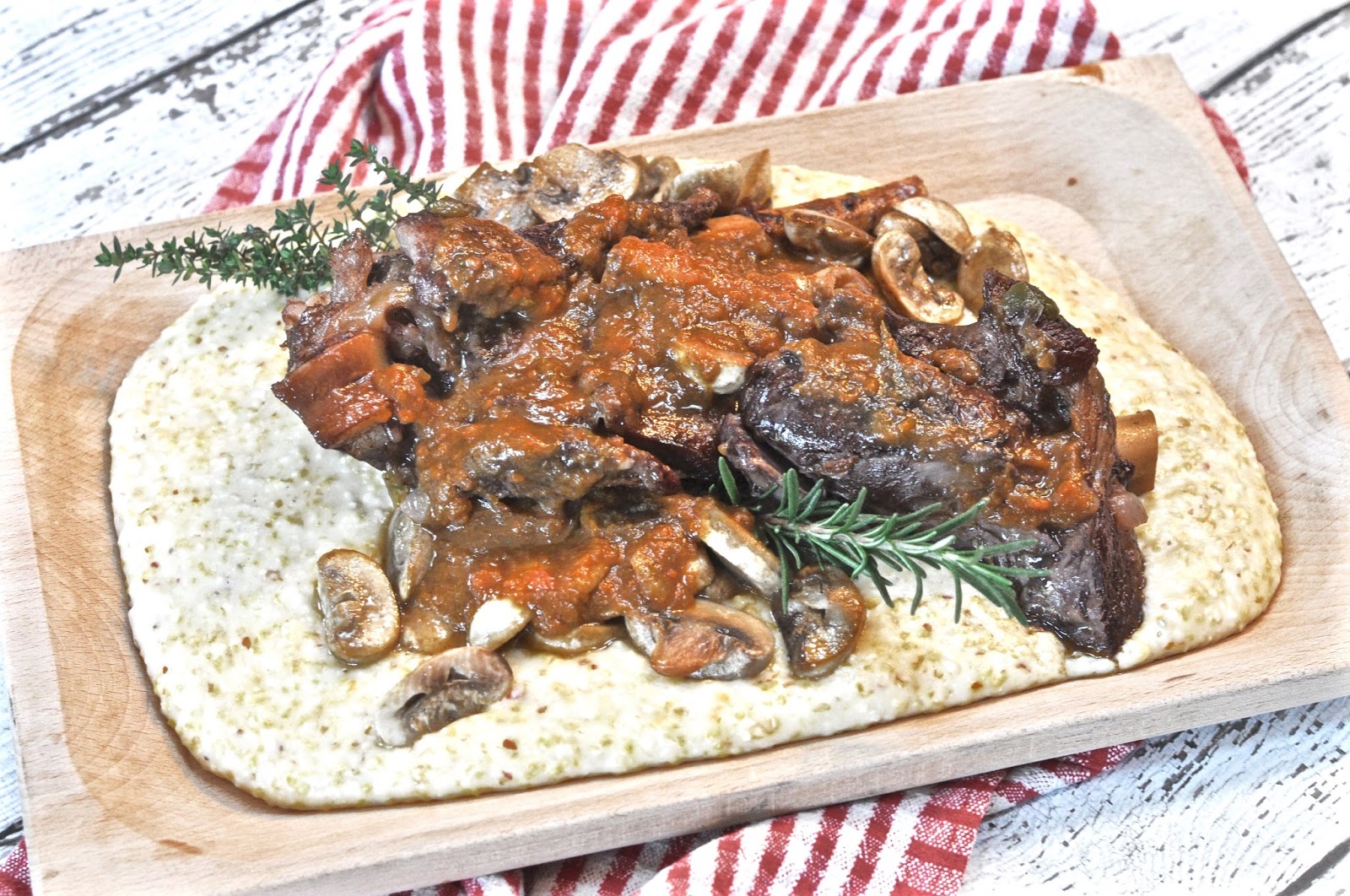
Braised Lamb Shanks with Polenta


OK, so this may not be the most photogenic of meals, but it is among the most delicious. Step outside your comfort zone, you non-lamb lovers, because after this meat braises for a few hours and melds with herbs and other ingredients, you're left with an earthy, flavorful meat that just falls off the bone and practically melts in your mouth.

Most of the "gamey" flavor associated with lamb is from the fat, which is why I trim off any possible fat from legs or racks of lambs I buy. But these shanks, the last pieces left from last year's purchase of half a lamb from a friend who raises them, were nearly devoid of fat. The white part you see below is more sinew than fat, which breaks down in the braising process. Each of these shanks held enough meat to serve two people comfortably.

Start out by browning the shanks in a Dutch over over medium high heat, with a little olive oil to coat the bottom.


Add some onion, celery, garlic, and carrots to the pan, as well as wine, chicken broth, tomatoes and herbs - in this case thyme and rosemary from my garden and bay leaves from my potted plant. Most supermarkets these days sell a plethora of fresh herbs, but use dried if you live in the hinterlands and can't find fresh.


You could simmer this on top of the range, but if you place it in the oven at moderate temperature, you can just forget about it for two or three hours. No stirring necessary.


Open the lid to a divine aroma (and a messy pan, I grant you, but it cleans easily enough if soaked for a while). Carefully remove the lamb to a warm platter, and throw out the herb bouquet and bay leaf. Use a stick blender to make a sauce of the remaining ingredients (or pop into a standing blender and mix). 


Serve the lamb shanks with creamy polenta (as above - recipe here for a "no-stir" polenta recipe or here for slow-cooker polenta from Michele Scicolone). If polenta's not your thing (WHAT?!!), serve with mashed potatoes, noodles or rice, pouring the sauce over all.


Braised Lamb Shanks


2 lamb shanks (about 3/4 pound each)


olive oil, to coat bottom of pan


1 onion, diced


1 celery stalk, diced


2 large carrots, diced


6 garlic cloves, minced


1 1/2 cups dry red wine


1 1/2 cups chicken broth


3 or 4 tomatoes, peeled and chopped


3 T. tomato paste


a few sprigs of fresh thyme


1 large sprig of fresh rosemary


1 bay leaf


salt, pepper


In a heavy casserole or Dutch oven, sauté the lamb shanks in a little olive oil until browned. Remove the shanks and add the onion, celery, and carrots to the pan, sautéing until softened. Add the garlic and cook another minute or two.


Place the lamb shanks back into the Dutch oven and add the rest of the ingredients. Place a lid on the top and cook in a 350 degree oven, checking after two hours. It may need another 1/2 hour to one hour until the meat is fork tender.


Remove the meat from the pan, keeping warm on a heated platter. Remove the herbs and with a stick blender, puree the sauce. Serve the sauce over the lamb shanks, with roasted mushrooms and polenta, if desired.


Bookmark and Share

Tuesday, January 22, 2013

Almost "No-Stir" Polenta and Mushroom Ragù


With daytime temperatures dipping to below freezing here in the Northeast U.S., it's time for heartier foods. Yea, I know, you're all sated from rich holiday foods, but if there's one thing I can't resist during cold weather, it's a heaping plate of polenta - with cheese, with sausages or in this case, with mushroom ragù. It's featured on many of the menus along the mountain huts in Italy where skiers pop in mid-day for a bit of sustenance for the rest of their run. It was truly needed last week while I was skiing in the Val Gardena, a valley of three villages in the northeastern region called Alto Adige. The snow fell practically non-stop and is continuing this week.


This is what the area looked like last week, when you couldn't even see the mountains in the distance.


Here's the same scene taken during a different ski trip, when the sun revealed the grandiose peaks.


[Jan-Feb 2010 Italy 702[3].jpg]


With such low visibility, the skiing was cautious and the stops were frequent, including one for a plate of this soft polenta topped with cheese and served with mushrooms on the side:


But you don't need to take a trip to the Val Gardena to enjoy this dish. In fact, I made a similar version, but with tomatoes, before I left for Italy, using dried porcini mushrooms and baby portabella mushrooms. If you can't find the porcini, use any combo of mushrooms that suit your fancy.


After the mushrooms simmer in the sauce for a good hour, you end up with a rich and flavorful ragù perfect for slathering over the polenta.


I own a sturdy copper pot with an electric motor that stirs the polenta all by itself - called a "paiolo." Click the button at the lower left to get a demonstration.


 It is pretty nifty but not really necessary to making polenta. Last month I watched a TV segment of "America's Test Kitchen" featuring a way to make polenta without stirring (well, almost, except at the very beginning.) During Christmas week, I served both versions -- from the paiolo and the "no stir" method --  to some Italian friends, and they declared them equally good.


Most people use water in their polenta, but sometimes I add milk, especially if I'm having company. If you want to be really decadent, try using some cream too. In that case, just make sure you take an extra run or two down the mountain.


Mushroom Ragù

printable recipe here


1 oz. dried porcini

8 oz. baby bella mushrooms (or another variety you prefer)

2 T. olive oil

1/2 carrot, minced

1/2 cup chopped onion

1 garlic clove, minced

1/2 of a 28 ounce can crushed tomatoes

1/4 cup red wine

1 T. tomato paste

about 1 cup of the liquid from soaking the porcini mushrooms

1 bay leaf

1 sprig rosemary


Rehydrate the dried porcini in two cups of warm water for about a half hour. Drain and chop the mushrooms, and strain the liquid to filter out any dirt or sand particles. Saute the mushrooms in the olive oil, and add the carrot, onion and garlic until softened. Add the rest of the ingredients and simmer gently for about an hour until thick and rich. If it gets a little too thick, add more of the liquid from the porcini. Serve over steaming polenta.


Almost no-stir Polenta

From America's Test Kitchen


Why this recipe works:


If you don’t stir polenta almost constantly, it forms intractable lumps. We wanted creamy, smooth polenta with rich corn flavor, but we wanted to find a way around the fussy process.

The prospect of stirring continuously for an hour made our arms ache, so we set out to find a way to give the water a head start on penetrating the cornmeal (we prefer the soft texture and nutty flavor of degerminated cornmeal in polenta). Our research led us to consider the similarities between cooking dried beans and dried corn. With beans, water has to penetrate the hard outer skin to gelatinize the starch within. In a corn kernel, the water has to penetrate the endosperm. To soften bean skins and speed up cooking, baking soda is sometimes added to the cooking liquid. Sure enough, a pinch was all it took to cut the cooking time in half without affecting the texture or flavor. Baking soda also helped the granules break down and release their starch in a uniform way, so we could virtually eliminate the stirring if we covered the pot and adjusted the heat to low. Parmesan cheese and butter stirred in at the last minute finishes our polenta, which is satisfying and rich.


Coarse-ground degerminated cornmeal such as yellow grits (with grains the size of couscous) works best in this recipe. Avoid instant and quick-cooking products, as well as whole-grain, stone-ground, and  regular cornmeal. Do not omit the baking soda—it reduces the cooking time and makes for a creamier polenta. The polenta should do little more than release wisps of steam. If it bubbles or sputters even slightly after the first 10 minutes, the heat is too high and you may need a flame tamer, available at most kitchen supply stores. Alternatively, fashion your own from a ring of foil. For a main course, serve the polenta with a topping or with a wedge of rich cheese or a meat sauce. Served plain, the polenta makes a great accompaniment to stews and braises.


7 1/2 cups water 1 1/2 teaspoons table salt pinch baking soda (I like to use a combination of milk and water - proportions are up to you.)

1 1/2 cups coarse-ground cornmeal

2 tablespoons unsalted butter 4 ounces good-quality Parmesan cheese , grated (about 2 cups), plus extra for serving

ground black pepper


1. Bring water to boil in heavy-bottomed 4-quart saucepan over medium-high heat. Stir in salt and baking soda. Slowly pour cornmeal into water in steady stream, while stirring back and forth with wooden spoon or rubber spatula. Bring mixture to boil, stirring constantly, about 1 minute. Reduce heat to lowest possible setting and cover.

2. After 5 minutes, whisk polenta to smooth out any lumps that may have formed, about 15 seconds. (Make sure to scrape down sides and bottom of pan.) Cover and continue to cook, without stirring, until grains of polenta are tender but slightly al dente, about 25 minutes longer. (Polenta should be loose and barely hold its shape but will continue to thicken as it cools.)


3. Remove from heat, stir in butter and Parmesan, and season to taste
with black pepper. Let stand, covered, 5 minutes. Serve, passing
Parmesan separately.


Bookmark and Share